
The Question We Cannot Escape
When Near-Term Crash and Long-Term Transformation Are Both True Simultaneously

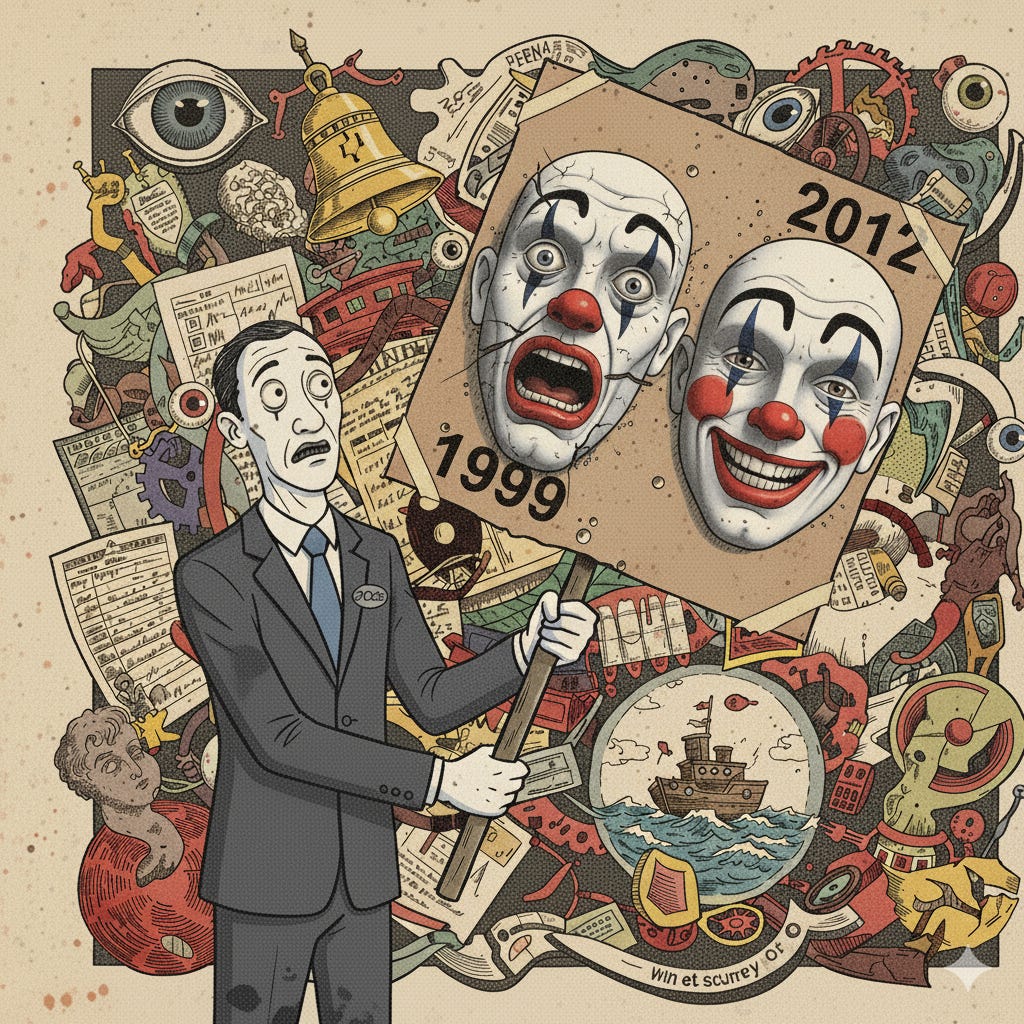
The AI Paradox explores a question nobody wants to ask loudly: Are we in 1999, months before the crash that erases $5 trillion, or 2012, years into the infrastructure build that changes everything? We trace the pattern through railroad manias, electricity’s seventy-year wait, and dot-com ghosts resurrected as unicorns. The uncomfortable truth settles in layers—both prophets are right, near-term crashes validate rather than invalidate long-term transformation, and we inherit broken instruments that still sing if we listen. This article was crafted using Oriflow’s 6-Layer Cognitive Design Engine.
The Bell Rings
9:30 AM. The bell rings.
Except this morning, nobody knows what time it marks. 1999 time? 2012 time? The screens flicker. The traders wait. The bell keeps ringing, but the time it marks feels wrong.
January 2025. Nvidia down seventeen percent. The bell rings at the same moment it always does. But the moment has changed.
The question sits in conference rooms where money pools, in server farms where GPUs hum their heat-song through the night, in research labs where papers multiply faster than understanding. The question nobody asks loudly because asking reveals doubt, and doubt moves markets faster than certainty:
Are we in 1999?
Or 2012?
Months before the crash that erases $5 trillion? Or years into the infrastructure build that changes everything?
The bell rings. We listen. We cannot tell which sound is real.
Two Prophets
The Bull stands in Redmond, data centers rising like glass cathedrals behind her. She speaks of money. Real money—$575 billion flowing through Amazon’s servers, Satya Nadella’s ten-year horizons, leaders who remember 2000 and won’t make those mistakes again. GitHub Copilot making developers faster. Consultants more productive. Six percent of companies using AI already, and that number growing.
“This isn’t speculation,” the Bull says. “It’s transformation.”
The Bear sits in a university office, surrounded by papers that say otherwise. $560 billion invested. $35 billion earned. The ratio cannot hold. He speaks of hallucinations mathematically inevitable, of LLMs that pattern-match but don’t reason, of Nvidia trading at seventy times earnings when mature tech trades at twenty.
MIT economist Daron Acemoglu: 1-1.5% GDP increase over a decade. Hardly revolutionary. Gartner’s warning: 30% of GenAI projects abandoned by year’s end. “This isn’t transformation,” the Bear says. “It’s another mania.”
Two rooms. Same building. Same data showing different futures.
The bull floor hums with confidence. The bear floor whispers caution. Between them, the question echoes: Which truth is true?
How the Question Formed
November 2022. ChatGPT reaches 100 million users in two months—faster than the Internet, faster than smartphones, faster than anything. The markets wake up. Microsoft invests $10 billion. Google launches Bard in panic. Startups multiply like cells dividing—100 LLM wrappers, 200, 500. Every pitch deck carries the same prefix now: AI-powered, AI-first, AI-native.
The valuations climb. Nvidia breaks $1 trillion, then $2 trillion, then $3 trillion. The Magnificent Seven capture 30% of the S&P 500. Thirty percent. Concentration not seen since 1999. Or 1929.
The pattern starts feeling familiar.
Founders in their twenties claiming they’ll change everything. Investors throwing billions at companies with no revenue. Everyone convinced this time is different. The whole checklist of mania: parties where everyone’s building the same thing with different branding, conferences where the future gets announced hourly, demo days that blur into one continuous promise.
But then—
Wait.
These aren’t twenty-year-old kids. These are Microsoft and Google and Amazon, companies that weathered 2000, companies with forty percent operating margins. Azure making money whether AI works or not. AWS profitable before AI, profitable during AI. Google’s ad business printing cash while it experiments.
And the technology works. Copilot ships, Claude answers, Midjourney generates. These aren’t vaporware promises. These are products people use daily.
So which is it?
Bubble or build?
1999 or 2012?
The question fractures. If we’re in 1999, sell everything, move to cash, wait for the 78% crash. If we’re in 2012—three years post-recession, infrastructure proven—then this is the beginning.
Wrong guess costs billions.
The bell rings. The markets move. Nobody knows which way is up.
The $1 Trillion Morning
January 2025, and a Chinese lab releases a model built for $6 million.
$1 trillion disappears in a morning.
The narrative cracks. Maybe the moat isn’t a moat. Maybe these models commodify faster than anyone predicted. Maybe the emperor has no clothes, or maybe he does but they’re made in Shenzhen for a fraction of the cost.
The rupture exposes what was always there: The numbers don’t add up. They never did. $560 billion invested. $35 billion earned. That’s not a business model. That’s a bet on five years, ten years, fifteen years paying off.
History offers no clear answer.
Railroads: Four major crashes between 1837 and 1873. Every crash bankrupted half the companies. Every crash, the track miles kept growing. 1,000 miles. 6,000. 30,000. 70,000. The companies were mortal. The infrastructure was not.
Electricity: Four speculative bubbles between 1882 and 1929—crashes of 60%, 40%, 50%, 89%. Yet adoption never stopped. In 1885, less than 2% of homes had electricity. By 1950, 95%. Seventy years. Multiple crashes. Universal transformation.
The dot-com crash: Nasdaq peaks at 5,048 in March 2000. Bottoms at 1,114 in March 2002. Down 78%. Five hundred companies bankrupt—Pets.com, Webvan, Kozmo—all gone. But Amazon survived. Google emerged. The Internet devoured everything. The crash killed companies. The transformation proceeded.
The pattern: Speculation finances infrastructure. Crashes destroy companies. Infrastructure persists. Transformation takes decades.
But which decade are we in?
The modern AI era—if we date it from GPT-3’s 2020 debut, when serious money started flowing—reached Year Five in 2025. Internet at Year Five was 1999, five months before the peak. Cloud computing at Year Five was 2011, two years before universal adoption.
Same year. Different outcomes.
We’re asking the wrong question. “Bubble or not?” misses the point. Both are true. AI is a bubble. AI is transformative. The question isn’t which. The question is: What happens when both are true simultaneously?
When Both Are Right
Jerome Powell stands at the Federal Reserve podium. January 2024. “These companies actually have earnings,” he says, “unlike the dot-com era.”
He’s right. The spreadsheets show it. Microsoft: $211 billion. Amazon: $575 billion. Numbers that don’t vanish when you refresh the page.
Gary Marcus, December 2024, writes what the engineers already know: “LLMs are fundamentally pattern matchers, not reasoning systems.”
He’s also right. The hallucinations arrive like clockwork. Not bugs to fix. Architecture. Mira Murati, OpenAI’s CTO, says it plainly: “Hallucinations are a fact of LLM architecture.” The system works exactly as designed. The errors are structural.
Inside Goldman Sachs, two teams write reports.
The investment research team, seventh floor: “AI dominated by few incumbents with strong balance sheets.” The spreadsheets glow steady green.
The technology research team, ninth floor, same building: “Massive increase in spending with unclear path to returns.” Same spreadsheets. Different conclusions. The green looks uncertain now, yellow creeping in at the edges.
Same firm. Same data. Same building. Different floors. Different futures visible from different windows.
The synthesis is uncomfortable. Both sides are correct. This is what economists call a “productive bubble”—excessive speculation financing genuine infrastructure. Near-term valuations face correction. Long-term transformation remains likely. Companies will die. Products will ship. Markets will crash. Society will change in ways we won’t notice until the world is unrecognizable.
The reckoning arrives differently for different players.
The engineer who joined an AI startup in 2024 watches Nvidia’s chart like a prophet reads entrails. Equity package heavy, salary light. If the correction comes—when it comes—the options vest underwater. The dream was: Get in early, ride the wave, cash out before the turn. But when is the turn?
The investor who bought Nvidia at $120 in 2023 feels like a genius. The investor who bought at $900 in late 2024 feels nauseated watching it swing 15% daily. Same stock. Different entry point. Everything depends on timing. Timing depends on: 1999 or 2012? Nobody knows.
The academic who spent forty years researching neural networks in obscurity, watching the field yo-yo—Perceptrons (1958), AI winter (1970s), Backpropagation (1986), AI winter again (1990s), Deep learning (2012), now this. Geoffrey Hinton won the Turing Award in 2018 for work done in 1986. Thirty-two years between the work and the recognition. The cycles never stop.
What emerges is a timeline question disguised as a value question. “Will AI transform society?” Wrong question. The question is: “How long will it take?” Valuations are either justified (if transformation is five years away) or absurd (if transformation is fifty years away).
Electricity took seventy years from Edison’s 1882 Pearl Street Station to 1950s universal adoption. The stock bubbles and crashes happened throughout. The light bulbs kept multiplying. The factories kept redesigning. The transformation proceeded—slowly, generationally, unstoppably.
If AI follows the electricity pattern—and every General Purpose Technology does—then we’re in Year Five of a fifty-to-seventy-year cycle. Current euphoria prices in 2030 outcomes. Actual transformation arrives 2050-2070. The timing gap is forty-five years.
That’s not bearish or bullish. That’s physics. Society changes slowly. Institutions adapt generationally. Workforce retraining takes decades. The technology might be ready. The world is not.
We Cannot Tell
The question we cannot escape isn’t the question we’re asking.
“Are we in a bubble?” Yes.
“Is AI transformative?” Yes.
The question is: What do you do when both are true?
The bell rings at 9:30 AM every day. The markets open. Money moves—some toward the future, some away. The bell marks time, but time unfolds in layers: five-year layers where apps boom and crash, fifteen-year layers where platforms build, fifty-year layers where society forgets how it restructured.
We’re in Year Five. Of something. Five years into what timeline?
The bell rings. The prophets speak. One says crash. One says climb. Both certain. Both probably right about different timelines.
The uncomfortable truth: We won’t know which prophet was correct until the bell has rung a thousand more times. Until companies have failed and persisted. Until infrastructure has been built, and rebuilt, and built again. Until enough time passes that the question transforms into history, history transforms into pattern, pattern transforms into knowing.
But by then, the knowing comes too late.
Now, in 2025. Year Five. The bell ringing. The prophets speaking. The markets moving.
Now, when we cannot tell which sound is real.
The question we cannot escape: Are we choosing the future? Or betting on a mirage?
Are we in 1999?
Or 2012?
The bell rings. We listen. We still cannot tell.
But we must choose anyway.
Next in series: “The Two Prophets” — Inside the bull and bear cases