
The Country That Exported Code But Imported Computers
Episode 1: Foreign Exchange Madness, Body Shopping, and How Desperation Became Strategy by Accident

The hum stopped first. That’s what the engineers remembered, not the official pronouncements or the political theater in Delhi or even the Foreign Exchange Regulation Act’s dry prose about equity dilution. What they remembered was the fluorescent silence in the IBM office on that last day of May 1978, when the air conditioning shut down for good and the machines stood waiting for maintenance that would never come.
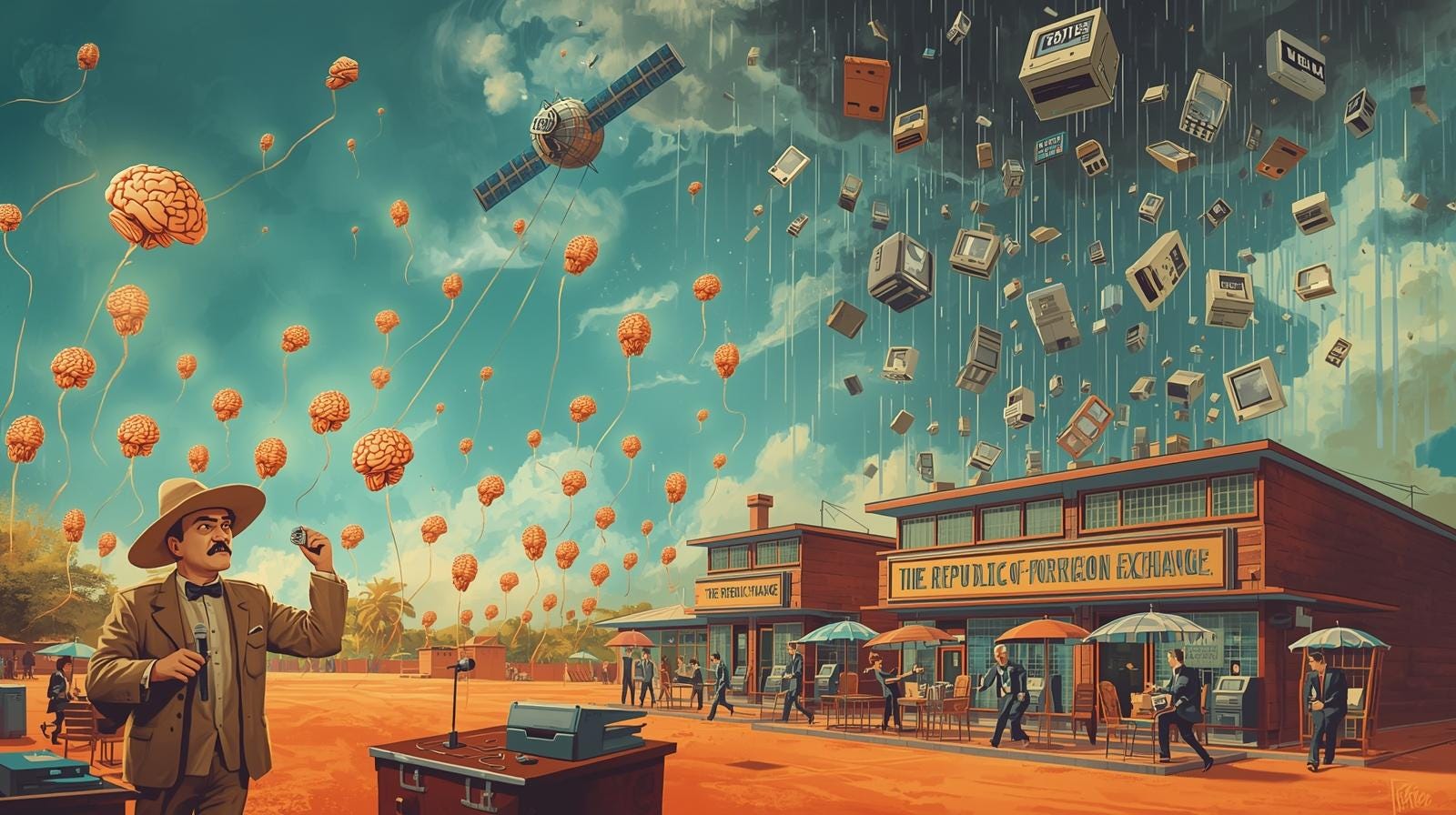
Eight hundred installations across India. Terminals gathering dust in Bombay offices. Mainframes going cold in Calcutta banks. Punch-card readers in Delhi government buildings that would never read another card. IBM sold them at book value, which in accounting terms meant their depreciated worth, which in human terms meant nearly free, which in practical terms meant nearly useless without the people who knew how to make them sing.
An engineer, let’s say his name was Ramesh though it could have been Suresh or Mahesh or any of the hundred men who stood in similar rooms that day, watched the lights blink off one by one. He’d spent three years learning this machine’s language, its COBOL commands, its particular hungers for electricity and cold air. Now it was just metal and silicon, a monument to a presence that had evaporated.
The official story went like this: India stood up, India said no, India chose indigenous capability over foreign dependence. The Foreign Exchange Regulation Act of 1973 required multinational corporations to dilute their equity to 40% Indian ownership. Economic sovereignty made legislative. Nationalism crystallized into percentage points. When IBM refused, citing technology transfer concerns and equity control requirements, the government held firm. George Fernandes became the symbol of this defiance. IBM wasn’t the only giant to leave. Coca-Cola shuttered its operations rather than share its secret formula. Philips left. ICL left. The exodus of 1977 and 1978 was supposed to clear space for Indian enterprise to bloom.
But what the official story couldn’t hold was the scramble that followed. ECIL, Electronics Corporation of India Limited, had been anointed the government’s chosen champion back in 1967. By 1976 it had become obvious that ECIL couldn’t deliver computers that were technologically sophisticated, price competitive, or delivered on time. The indigenous capability that was supposed to replace IBM had already failed before IBM packed its bags.
June 1978. The government scrambled. CMC Limited, Computer Maintenance Corporation, incorporated in 1975 with 100% government equity, took over the maintenance of those 800 IBM installations. Over 800 data processing and computer systems across India, suddenly orphaned, suddenly the government’s problem. But CMC could only maintain hardware. Who would write the software? The private sector smelled opportunity.
The vacuum was not empty. It was a space waiting to be claimed by whoever moved first.
The Engineers Who Stayed
Four years before IBM left, a small team at Tata Consultancy Services gambled twenty-four thousand dollars. That was the contract value for a hospital accounting system conversion for Burroughs Corporation, from Medium Systems COBOL to Small Systems COBOL. In 1974, twenty-four thousand American dollars could barely buy a decent Bombay flat. But it was India’s first recorded offshore software delivery, and TCS didn’t even own a Burroughs machine.
They built the whole system on an available ICL computer and invented an ingenious filter to transfer it to Burroughs. A giant leap of faith to deliver software without compatible hardware. Translation as survival. Making incompatible systems speak.
In Bombay in those years before the IBM exit, there was a workspace rhythm. The mechanical clatter of punch-card readers. The green phosphor glow of terminals. The smell of solder and old paper and stale chai. Ceiling fans turned overhead because air conditioning was for the machines, not the men. The heat was thick, monsoon dense, and the programmers worked in short sleeves, their notebooks filling with handwritten COBOL. S. Mahalingam, then a young chartered accountant, led a six-member team, four in Bombay and two sent onsite to the UK. They wrote specifications for financial accounting software for Burroughs computers, sold it to building societies in Britain. Exported code. Exported expertise.
This was 1974. IBM was still in India. The exit was four years away. And TCS had a partnership with Burroughs that provided ninety percent of its overseas revenue.
Then 1978 arrived, first in May when IBM left, then again in December when the Burroughs partnership ended. TCS lost ninety percent of its overseas earnings. Forty-three key employees were transferred to a new joint venture called Tata Burroughs. The company found itself in unknown land with no business to call its own, having to begin afresh and restart the hunt for international clients. What once meant possibility now meant abandonment. The filter that solved a technical problem couldn’t solve a business one.
But others were watching the vacuum form.
Azim Premji saw it in 1977. IBM’s exit created what he called an opportunity to take advantage of the vacuum left behind. Wipro, still primarily a vegetable oil company, collaborated with the Indian Institute of Science in Bangalore. By 1981 they launched India’s first minicomputer based on the Intel 8086 chip, developed in an IISc laboratory. But the software division didn’t start until 1984. Offshore software development didn’t begin until 1990. Seven years from recognizing the opportunity to starting software. Thirteen years to pivot fully.
In 1978, the same year IBM left, HCL launched the HCL 8C microcomputer almost simultaneously with Apple in the United States, three years before IBM’s PC. Shiv Nadar’s innovation was specific to Indian infrastructure failure. The Power Shut Auto Restart unit, connected to a battery, saved all computations when power failed. Shrewd understanding of Indian working environment and frequent power cuts. But HCL Technologies, the software services arm, wasn’t spun off until November 1991. Thirteen years as a hardware company before the pivot.
January 1981. Seven software engineers in Narayana Murthy’s apartment in Pune, debating how to create a company that wrote software. The idea cost ten thousand rupees, provided by Murthy’s wife Sudha from her savings. The first office was the house they bought with a loan. They had no client for two years. In 1983, Data Basics Corporation from New York became Infosys’s first customer. That same year they moved to Bangalore. That same year their first minicomputer arrived, a Data General 32-bit MV8000. Two years of nothing, then something.
The pattern emerged with brutal clarity. Hardware dreamers who failed: ECIL, backed by government, failed by 1976. DCM Data Products, with its indigenous 8-bit and 16-bit computers, couldn’t compete with branded PCs and became a services company. ORG Systems, with its Sperry tie-up in minicomputers, struggled and faded. Hardware pivots who survived: HCL and Wipro eventually realized software services was where survival lay. Software-first pioneers: TCS forced to restart after Burroughs, Infosys starting from nothing, they understood that services, not products, was India’s opening.
The empty machine rooms were filling, but not with what anyone expected. CMC technicians did maintenance, but the software, the invisible labor, the real value, was being written elsewhere by private companies who understood that code traveled better than hardware. The hardware companies built monuments to self-reliance. The software companies built businesses. Only the businesses survived.
The Accidental Mandate
Five years before IBM left, the government had created something called SEEPZ, Santa Cruz Electronics Export Processing Zone, in 1973. It allowed 100% foreign-owned enterprises for software exports. Duty-free import of computers for those who exported software. By the 1980s, more than eighty percent of India’s software exports came from SEEPZ alone.
This was not strategy. This was desperation.
India faced a foreign exchange crisis in the 1970s and early 1980s. Software firms that needed to import computers were required, mandated by policy, to earn foreign exchange through software exports. The constraint became the model. The numbers tell the story of a forced march. In 1975, eight and a half million rupees in software exports. By 1981, forty-four million. By 1986, four hundred and twenty million rupees. The growth was exponential, but it wasn’t chosen. It was mandated.
The policy cascade came rapid-fire between 1983 and 1986. Import Policy in 1983 acknowledged that software needed hardware. The New Electronics Policy in January 1984 brought Rajiv Gandhi’s modernization: technology transfer, science parks, export processing zones. The Computer Policy of 1984 liberalized computer imports for export-oriented firms. The Software Policy of 1986 gave formal recognition to software export via data communication links. The government was writing policies to encourage what was already happening out of necessity.
The body shopping model emerged from visa arithmetic. In 1980 the U.S. State Department issued 26,535 L-1 visas. H1-B didn’t exist until 1990. By the late 1980s, L-1 visa entries averaged sixty to seventy thousand annually. Indian engineers became temporary employees at American client sites, keeping software work within U.S. borders but billing from Indian companies. Onsite first. Offshore later.
In 1985, Citibank validated the entire model. They set up Citicorp Overseas Software Ltd at SEEPZ with two crore rupees capital investment for export of software for the computerization requirements of Citibank worldwide. India’s first captive IT services center. An American bank choosing India for software seven years after IBM left. Texas Instruments followed the same year, the first multinational to set up a wholly owned R&D center in India.
The filter was no longer just TCS’s technical hack for transferring code between incompatible systems. It was India’s national position. Filtering between Western technology needs and domestic constraints. Making American demand and Indian supply speak to each other through ingenious translation.
India didn’t strategically choose software services. Foreign exchange crisis forced exports. IBM’s exit cleared space. Government policy created infrastructure out of desperation. But Indian engineers, TCS’s twenty-four thousand dollar gamble in 1974, the offshore delivery model, the filter mentality, they turned crisis into capability. Luck and strategy intertwined like monsoon rain and river flood. You can’t separate them. The rain causes the flood but the river was already there waiting.
An engineer born in 1978, the year of the IBM exit, the year of the Burroughs split, the year the hum stopped, would be forty-seven now. Old enough to have built a career in the industry that rose from the vacuum. Young enough to wonder what was lost. What was inherited: eight hundred empty installations, a foreign exchange crisis, failed indigenous computer companies, a twenty-four thousand dollar precedent, a government desperate enough to mandate exports. What was built: TCS, Infosys, Wipro, HCL becoming global services giants, eighty percent of software exports from a single zone, an export model that scaled to billions. What was not built: indigenous hardware capability, software products, platforms.
The rooms were never truly empty. Ramesh, or Suresh or Mahesh, stood there on May 31, 1978, watching the lights blink off. But his mind wasn’t empty. He knew COBOL. He knew systems. He knew that software, unlike hardware, could travel through telephone lines, through data links, through the ingenious filters that made incompatible systems speak. In two years he’d be writing code for export. In five years there would be SEEPZ and Citibank and eighty percent of India’s software flowing through that single zone. In ten years India would be synonymous with IT services.
But in that moment, May 31, 1978, he just watched the machines go silent and wondered what came next.
India never owned the platforms. Never built the mainframes or the operating systems or the architectures. Always translating. Always filtering. Always making American IBM speak to British Burroughs, making incompatible systems compatible through ingenious hacks. The instruments were broken. But they played anyway. That’s the inheritance. That’s 1978. That’s where India’s IT industry began, not in triumph but in translation, not in strategy but in scramble.
The vacuum filled. Services, not products. Integration, not innovation. The back office of the world, not its architecture. But it filled.
The hum stopped. The room emptied. The engineers stayed. And in the silence they learned to write a different kind of music, one that traveled through wires and across oceans, one that didn’t need the machines to stay, only the minds that knew how to make them sing from a distance.
This was the apprenticeship. The scramble years. The translation years. From 1978 to 1986, Indian IT learned to export services, to body-shop engineers, to offshore delivery, to filter between incompatible systems. It learned to survive on twenty-four thousand dollar contracts and foreign exchange mandates and government-created export zones. It learned that code traveled and hardware didn’t, that services scaled and products failed, that being the back office was better than being nothing at all.
But this was still just the beginning. The real test would come later, when the entire world would need what India had learned in those eight years of scrambling. The test would come in 1999, when the world’s computers threatened to forget how to count past midnight on December 31st. That crisis would have a name: Y2K. And India, trained in the art of fixing other people’s code, fluent in the language of offshore delivery, expert in the filter mentality of making incompatible systems work, would be ready.
The vacuum of 1978 would become the opportunity of 1999. But first, India had to learn to crawl. Then it would learn to run. Then it would learn to fly.
The hum had stopped. But the music was just beginning.